
Introduction:
India is the world’s second-largest food producer and one of the most significant players in global agri-food trade. With a strong agricultural base across diverse climatic zones, a cost-competitive supply chain, and centuries of expertise in spices, pulses, and cereals, India is uniquely positioned to meet the world’s growing appetite for high-quality, naturally sourced food products, as also highlighted by the Food and Agriculture Organization (FAO).
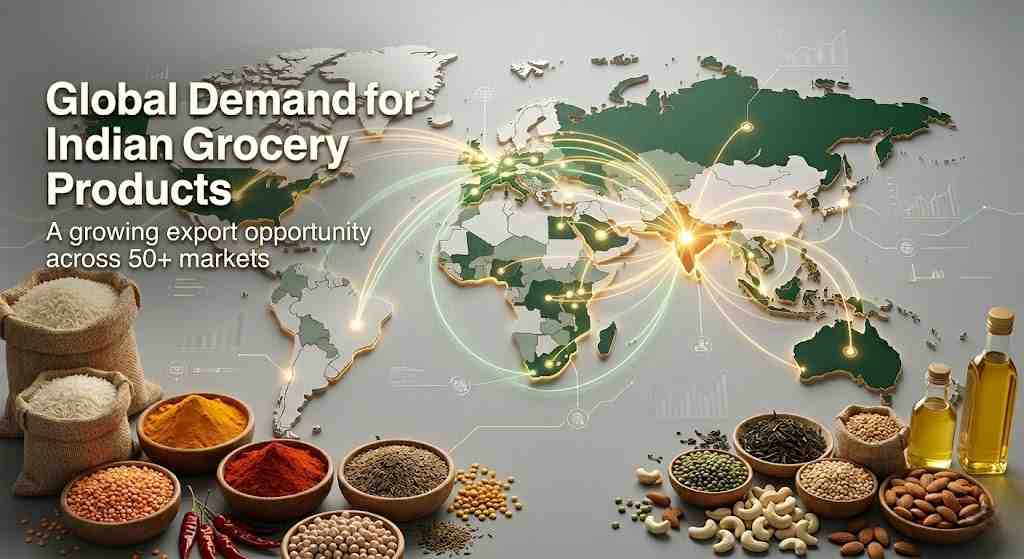
Global demand for Indian grocery products has moved well beyond ethnic food aisles. Today, Indian rice, spices, pulses, and dry fruits line the shelves of mainstream supermarkets in Europe, the GCC, North America, East Africa, and Southeast Asia. This shift is driven by three interconnected forces: the global mainstreaming of Indian cuisine, a sharp consumer pivot toward plant-based and health-conscious eating, and the rapid expansion of Indian diaspora communities across the world.
For importers, distributors, and wholesale buyers, this represents a structural and long-term opportunity — not a passing trend. This guide breaks down the top 10 Indian grocery categories by global demand, with practical insights on margins, logistics, and market positioning.
Why Indian Grocery Products Lead Global Import Demand
Several macro-level forces are converging to make Indian grocery products one of the most consistent and scalable import categories worldwide. Export growth and international trade development are also supported by organizations such as the Agricultural and Processed Food Products Export Development Authority (APEDA).
- The global plant-based movement has turbocharged demand for lentils, chickpeas, and other pulses — India is the world’s largest producer and exporter of pulses.
- Growing health awareness is driving consumers toward natural, minimally processed foods like turmeric, jaggery, and cold-pressed oils — all Indian specialties.
- Indian cuisine is now the world’s most widely consumed ethnic cuisine, creating sustained retail and food service demand for spices, flours, and condiments.
- Supermarkets in the US, UK, EU, and GCC are actively expanding their ‘World Foods’ and ‘Free-From’ sections, creating shelf space for Indian imports at scale.
- Private label opportunities allow importers to build proprietary brands on top of Indian supply chains, increasing margins and brand equity.
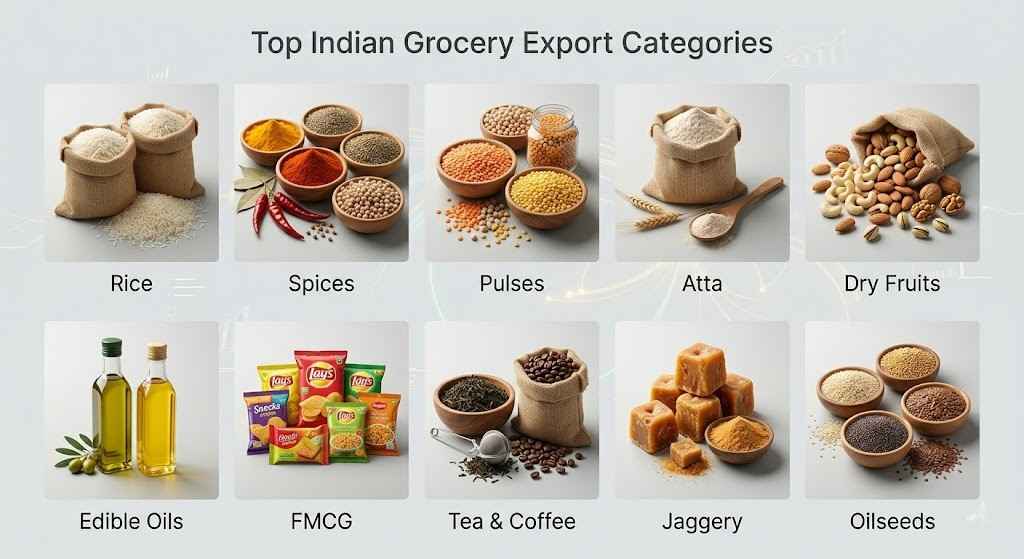
Top 10 Indian Grocery Products in Global Demand
1. Rice (Basmati & Non-Basmati)
Rice is the single largest category in Indian food exports by volume. India accounts for approximately 40% of global rice exports, with basmati commanding a premium across Middle Eastern, European, and North American markets. Non-basmati varieties — including parboiled, sona masoori, and broken rice — serve high-volume, price-sensitive demand in Africa and Asia.
| Key Markets | Importer Advantage | HDL Global Edge |
| Middle East, East Africa, EU, UK | Volume driver; long-term contract potential | Bulk supply capability; consistent quality grading |
| USA, Canada, Australia | Stable, predictable demand; low churn | Basmati varieties meet US/EU food safety standards |
Importer Insight: Basmati rice carries strong brand-building potential in premium retail. Non-basmati works well in B2B bulk supply to food manufacturers and restaurants.
2. Indian Spices (Whole & Blended)
India produces and exports over 75 varieties of spices, accounting for nearly 25% of global spice trade by volume. According to the Spices Board of India, the country remains the largest exporter of spices globally.
Turmeric, cumin, chili, cardamom, coriander, and fenugreek are among the highest-demand exports. Blended masalas — such as garam masala, chaat masala, and biryani mix — are increasingly popular in retail channels globally.
India produces and exports over 75 varieties of spices, accounting for nearly 25% of global spice trade by volume. India’s spice exports crossed USD 4.3 billion in recent years and continue to grow, driven by surging Western interest in functional ingredients. Turmeric alone, with its well-documented anti-inflammatory properties, has become a mainstream wellness ingredient in supplements, teas, and processed foods.
| Key Markets | Importer Advantage | HDL Global Edge |
| USA, EU, UK, Canada, GCC | High value-to-weight ratio; strong margins | Blended spice expertise; private label packaging |
| Southeast Asia, Africa | Repeat purchase; essentials category | FSSAI, ISO, and Spices Board certified |
We offer private label blended spices in customized stand-up pouches, ideal for ethnic supermarkets and mainstream retail chains in the US and UK.
3. Pulses (Lentils, Chickpeas, Beans, Peas)
India is the world’s top producer and consumer of pulses, making it the most reliable source for global buyers. Red lentils (masoor dal), chickpeas (chana), yellow split peas, and black-eyed beans are in consistent global demand across South Asian diaspora markets, Middle Eastern kitchens, and Western health food sections.
The plant-based protein revolution has dramatically accelerated pulse imports in North America and Europe. Chickpeas, in particular, are now a primary ingredient in hummus, plant-based protein foods, and protein snacks — elevating the category far beyond its ethnic food origins.
| Key Markets | Importer Advantage | HDL Global Edge |
| USA, Canada, UK, EU, GCC | High repeat purchase; predictable volumes | Direct farm sourcing from Gujarat & MP |
| East Africa, Southeast Asia | Affordable protein; essential staple | Clean, sorted, machine-graded supply |
Importer Insight: Pulses offer one of the best risk-adjusted profiles in Indian grocery — steady demand, scalable supply, and no strong seasonality in retail consumption.
4. Wheat Flour & Grains (Chakki Atta)
Chakki-ground wheat flour (atta) is an essential staple for Indian, Pakistani, and Bangladeshi diaspora communities, making it a reliable category for importers targeting South Asian retail markets. HDL Global’s own Chakki Fresh Atta brand is a direct example of how Indian exporters are building consumer-facing brands in international markets.
With growing global interest in whole grain and stoneground flours, Indian atta is also finding audiences beyond the diaspora — particularly in health food channels in the UK, Canada, and Australia.
| Key Markets | Importer Advantage | HDL Global Edge |
| UK, Canada, USA, Middle East | Private label potential; brand loyalty | HDL Chakki Fresh Atta — export-ready brand |
| East Africa, Australia | Ethnic staple; recurring household buy | Multiple pack sizes; shelf-life optimized packaging |
5. Dry Fruits (Cashews, Almonds, Raisins, Pistachios)
India is a major processor and re-exporter of dry fruits, with strong value-added processing capabilities in cashews and raisins. Dry fruits occupy a premium shelf position globally and are consumed as healthy snacks, used in confectionery and gifting, and incorporated into health-food products such as trail mixes, granola bars, and nut butters.
The market is driven by two distinct segments: everyday snacking (mass retail) and premium gifting (festive and corporate). Both segments are growing, and Indian dry fruit processors offer competitive pricing across both.
| Key Markets | Importer Advantage | HDL Global Edge |
| GCC, USA, EU, Southeast Asia | High margin; premium positioning | Graded, cleaned, vacuum-packed supply |
| UK, Canada, Australia | Gifting & festive demand; year-round snacking | Custom retail packaging available |
Importer Insight: Dry fruits are one of the highest-margin categories in Indian grocery exports. Investing in premium packaging significantly increases shelf appeal and justifies higher price points.
6. Edible Oils (Sesame, Groundnut, Mustard, Cold-Pressed)
Edible oils are a daily consumption staple across every market globally. India’s key export oils — sesame, groundnut, and mustard — serve both household cooking and industrial food production. Cold-pressed variants are gaining traction in premium health food channels in Europe and North America, commanding significant price premiums over refined alternatives.
| Key Markets | Importer Advantage | HDL Global Edge |
| Southeast Asia, GCC, East Africa | Daily consumption; bulk contract opportunity | High-oleic and cold-pressed variants available |
| EU, UK, USA (health food) | Premium segment; strong growth trajectory | Certified organic options for export |
Challenge: Edible oils involve higher logistics costs due to bulk liquid handling. Importers should evaluate container loads and storage infrastructure carefully before entering this category.
7. Ready-to-Eat & FMCG Products
India’s FMCG food export segment is the fastest-growing in the grocery trade. It encompasses instant meal kits, ready-to-cook mixes (biryani, dal, curry paste), packaged snacks (namkeen, chakli, roasted nuts), and traditional sweets in shelf-stable formats. These products cater to a busy urban diaspora that craves authentic Indian flavors without the preparation time.
Indian FMCG brands like MTR, Haldiram’s, and Priya are already widely distributed globally. However, significant white space exists for private label and regional brand-building — especially in markets like East Africa, Southeast Asia, and the Caribbean.
| Key Markets | Importer Advantage | HDL Global Edge |
| USA, UK, Canada, GCC | Highest margin category; brand-building potential | Contract manufacturing & private labeling |
| East Africa, Southeast Asia | High demand; limited local competition | Shelf-stable; 12-18 month shelf life options |
8. Tea & Coffee (Assam, Darjeeling, South Indian Filter Coffee)
India is the world’s second-largest tea producer and a growing force in specialty coffee exports. Assam and Darjeeling teas carry strong global brand recognition, while South Indian robusta and arabica coffees are gaining traction in specialty café markets across Europe and Japan.
The opportunity in tea and coffee is not just volume — it is storytelling. Origin-specific, estate-branded, and organic variants command significant premiums in the specialty segment, making this an ideal category for brand-driven import businesses.
| Key Markets | Importer Advantage | HDL Global Edge |
| UK, Germany, USA, Japan | Premium & specialty segment; strong brand potential | Origin-traceable, estate-sourced supply |
| GCC, East Africa | Mass market; daily consumption | CTC, orthodox, green and herbal variants |
Importers exploring this category often evaluate supplier portfolios that include tea and coffee offerings within broader Indian export product ranges.
9. Sugar & Jaggery (Gur, Palm Jaggery, Coconut Sugar)
While refined sugar is a global commodity, jaggery and its variants are emerging as a premium alternative sweetener with genuine health positioning. Jaggery retains trace minerals, has a lower glycaemic index than white sugar, and carries strong clean-label credentials — making it attractive to health-conscious consumers and natural food brands in Western markets.
Coconut sugar and palm jaggery are the fastest-growing niche segments, driven by paleo, keto, and clean-eating trends.
| Key Markets | Importer Advantage | HDL Global Edge |
| UK, USA, EU (health food) | Niche but fast-growing; premium pricing | Organic & non-GMO certified jaggery available |
| GCC, Southeast Asia | Traditional use; mass market | Block, powder, and liquid formats available |
10. Oilseeds & Specialty Crops (Sesame, Groundnut, Flaxseed)
Indian oilseeds are workhorses of the global food manufacturing industry. Sesame seeds supply the global tahini, bakery, and confectionery markets. Groundnuts are critical inputs for peanut butter, snack foods, and oil production. Flaxseeds are a high-growth health food export, driven by their omega-3 content and superfood status.
| Key Markets | Importer Advantage | HDL Global Edge |
| China, Japan, GCC, EU | B2B bulk supply; consistent year-round demand | Machine-cleaned, sortex-graded, HACCP certified |
| USA, Canada, Europe | Flaxseed/superfoods premium market | Organic and conventional supply available |
Importer Insight: Oilseeds work best as a B2B category — sold directly to food manufacturers, snack producers, and oil refiners. Build volume with long-term annual supply contracts.
Common Mistakes Importers Should Avoid
Entering the Indian grocery import market offers strong opportunities, but avoidable mistakes can impact profitability, compliance, and long-term growth. Understanding these risks early helps importers build a more resilient and scalable business.
1. Choosing Suppliers Based Only on Price
Focusing purely on the lowest price often leads to inconsistent quality, delayed shipments, or compliance issues. In global trade, reliability and consistency matter more than short-term cost savings.
2. Ignoring Regulatory Compliance
Many first-time importers underestimate documentation and regulatory requirements. Failure to meet standards such as the US FDA food import requirements or EU regulations can result in shipment rejections, penalties, or long-term import restrictions.
3. Lack of Product Standardization
Variations in grading, moisture levels, or packaging can affect product acceptance in international markets. Importers should ensure suppliers follow consistent quality benchmarks and standardized processing systems.
4. Not Planning Logistics Properly
Freight costs, container optimization, and storage conditions significantly impact margins — especially for bulk categories like rice, pulses, and edible oils. Poor logistics planning can erode profitability even when product costs are competitive.
5. Overdependence on a Single Product Category
Relying on one category (e.g., only rice or only spices) exposes importers to market fluctuations. A diversified portfolio helps balance risk and ensures steady revenue streams.
6. Weak Communication with Suppliers
Lack of transparency, delayed responses, or unclear expectations can lead to operational issues. Importers should prioritize working with exporters who provide proactive updates and clear documentation support.
Why Choosing the Right Export Partner Matters
In global food trade, your supplier is not just a vendor — they are a long-term business partner who directly impacts your brand reputation, margins, and customer satisfaction.
1. Consistent Quality & Product Reliability
A dependable export partner ensures uniform grading, proper processing, and adherence to international standards across every shipment. This consistency is critical for maintaining trust with distributors and retailers.
2. Compliance & Documentation Support
Experienced exporters understand country-specific regulations and provide complete documentation — from labeling to certifications — reducing the risk of delays or rejections.
3. Scalable Supply Chain
As your business grows, your supplier should be able to scale production, maintain inventory consistency, and handle larger volumes without compromising quality.
4. Private Label & Customization Capability
Modern importers are increasingly building their own brands. Exporters who offer private labeling, customized packaging, and product adaptation provide a significant competitive advantage.
5. Market Understanding & Advisory
The right partner doesn’t just supply products — they understand global demand trends, pricing dynamics, and category opportunities, helping importers make better strategic decisions.
Companies such as HDL Global represent this evolving model of export partnership, combining sourcing expertise, processing infrastructure, and international market experience to support importers across multiple product categories.
Conclusion:
The global demand for Indian grocery products continues to expand, driven by long-term shifts in consumer behavior, increasing health awareness, and the growing global presence of Indian cuisine.
For importers, the opportunity lies not just in sourcing products — but in building a well-structured, diversified, and compliant supply chain. Success in this space depends on selecting the right product mix, understanding market dynamics, and working with partners who prioritize consistency, transparency, and scalability.
Starting with strong foundational categories such as rice, pulses, and spices, and gradually expanding into value-added and premium segments, allows importers to build both volume and margin over time. With the right approach and the right partnerships, the Indian grocery import business can evolve into a stable, long-term growth engine in global food trade.
FAQ’s
High-margin categories include spices, dry fruits, and FMCG products, while rice and pulses offer stable, high-volume demand.
Importers must comply with regulations like US FDA, EU food safety standards, and proper labeling, along with supplier-side certifications such as FSSAI.
India offers diverse agricultural production, cost competitiveness, and strong export infrastructure across spices, rice, and pulses.
By partnering with reliable exporters who follow standardized grading, processing, and international compliance protocols.
Yes, many exporters provide private label solutions including customized packaging, branding, and product formulations.
Begin with 1–2 high-demand categories, test market response, and gradually expand into diversified product segments.