
Introduction
Africa’s FMCG sector is entering a new phase of growth—one shaped less by informal trade and more by structured retail expansion, urban consumption, and changing buying behavior. Supermarkets, mini-marts, and organized retail formats are steadily increasing their footprint across major cities and emerging urban centers.
As this shift continues, demand is moving toward packaged, standardized, and supply-reliable products—especially in food and daily-use categories. This is where India is becoming increasingly relevant as a sourcing partner.
According to insights from the World Bank, rising urban populations across Africa are directly influencing consumption patterns, with greater reliance on packaged goods. Similarly, reports from the African Development Bank highlight the expansion of retail infrastructure as a key driver of economic transformation.
Why African Supermarkets Are Turning to India Right Now
The increasing presence of Indian FMCG products across African supermarkets is not driven by short-term trade trends—it is the result of structural alignment between demand and supply capabilities.
African retailers are looking for products that balance affordability, consistency, and scalability. Indian suppliers, having operated for decades in a highly price-sensitive and high-volume domestic market, are naturally positioned to meet these expectations.
Industry analysis from KPMG indicates that in emerging markets, purchasing decisions in FMCG categories are increasingly influenced by supply reliability and price-performance balance rather than brand loyalty, especially in high-volume retail environments.
Market data platforms such as Statista also show that FMCG demand in developing regions is closely tied to affordability, product availability, and distribution efficiency—factors that strongly align with Indian manufacturing capabilities.
Key Reasons Behind This Shift
- Competitive pricing across staple and essential categories
- Strong manufacturing base with scalable production
- Availability of both bulk and retail-ready SKUs
- Improved logistics between India and African ports
Market Insight
For many supermarket buyers, the decision is less about “importing from India” and more about sourcing products that consistently meet price-performance expectations.
Why Indian FMCG Fits the African Market
The compatibility between Indian FMCG products and African markets is rooted in shared consumption dynamics rather than geographic proximity.
Both regions operate within environments where:
- Price sensitivity is high
- Daily consumption drives purchasing
- Small pack sizes improve accessibility
This has led Indian manufacturers to develop products that are inherently aligned with these conditions—particularly in categories like staples, spices, and ready-to-consume goods.
Structural Fit Factors
- Strong expertise in sachet and small-pack manufacturing
- Flexible production for multiple price tiers
- Familiar flavor profiles in food categories
- Ability to supply both mass-market and premium segments
Market Insight
Products designed for India’s mass market often translate effectively into African retail because both prioritize value, functionality, and repeat usage over branding alone.
Top 5 Indian FMCG Products in Demand
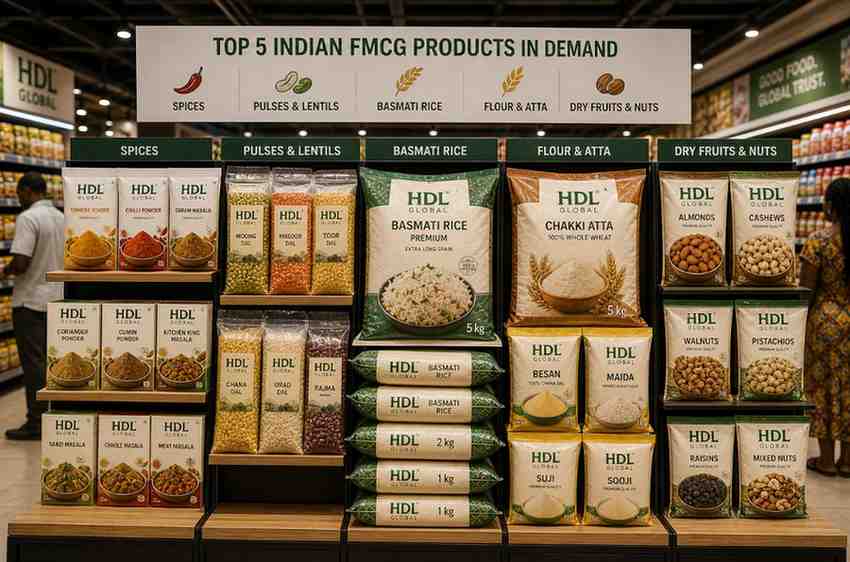
01. Blended Spices & Masala Mixes
Blended spices are currently the fastest-turning Indian FMCG category across African supermarkets, and this is not accidental—it is structurally aligned with existing cooking habits. Many African cuisines, particularly in East Africa and coastal regions influenced by historical Indian Ocean trade, already incorporate spice profiles similar to Indian blends. This eliminates the need for consumer education, allowing products like garam masala, chili powder, and turmeric to integrate seamlessly into daily cooking.
What has changed is not the demand, but the format and retail presentation. Modern supermarkets are seeing stronger performance from stand-up pouches with clear labeling, especially when bilingual (English + French/Portuguese). Smaller retail packs are improving both shelf turnover and per-unit margins, making this category highly attractive for distributors.
Where structure matters:
- Fast-moving SKUs: turmeric, chili powder, blended masalas
- Ideal retail sizes: 50g–100g (supermarket sweet spot)
- Additional channel: sachets (5g–10g) for kiosks
Buyer Consideration:
Focus on compliance (moisture content, aflatoxin levels). Regulatory rejection risk is real in several African ports.
02. Pulses & Lentils
Pulses are one of the most strategically important categories in India–Africa FMCG trade, largely due to their combination of affordability, nutrition, and storage stability. As urban populations grow, the need for cost-effective protein sources becomes more pronounced, and pulses naturally fill this gap.
India’s position as a major global producer allows exporters to maintain a consistent price advantage, making pulses highly competitive compared to other origins. Additionally, their long shelf life and compatibility with local dishes (soups, stews, mixed grains) make them a practical import choice.
What differentiates successful buyers is not category entry—but procurement timing and planning.
Key operational insights:
- High-demand SKUs: masoor, toor dal, moong dal
- Bulk format: 25kg bags dominate distribution
- Retail trend: 500g–2kg packs growing in supermarkets
Market Insight:
Moong dal is emerging as a fast-growing SKU due to quicker cooking time and perceived health benefits.
Buyer Consideration:
Align purchasing with Indian harvest cycles—forward planning can significantly reduce landed costs.
03. Dry Fruits & Nuts
Dry fruits operate as a premium, margin-driven category, but remain underdeveloped across many African supermarket shelves. This creates a clear opportunity. Indian processors play a key role here, especially in value addition—transforming raw materials (including African-origin cashews) into export-ready, consumer-friendly retail products.
Demand is being driven by a growing urban middle class seeking health-oriented and aspirational snack options. Unlike staples, this category is less about necessity and more about lifestyle positioning, making packaging and presentation critical.
Seasonality also plays a significant role, with demand spikes during festive and gifting periods.
Where structure helps:
- Fast-moving packs: 100g–250g retail pouches
- High-margin SKUs: mixed assortments, premium nuts
- Seasonal boost: festive gift boxes
Market Insight:
Festive formats (gift packs) often outperform regular SKUs in sell-through during peak seasons.
Buyer Consideration:
Insist on moisture control and proper sealing (vacuum/nitrogen flush) to maintain shelf life in tropical climates.
04. Wheat Flour (Chakki Atta) & Specialty Flours
Chakki atta and specialty flours represent a hybrid category—serving both diaspora-driven demand and a growing health-conscious consumer base. The “chakki” positioning (stone-ground, whole grain) resonates with consumers seeking less processed alternatives to refined flour.
At the same time, products like besan (chickpea flour) are expanding beyond ethnic usage into mainstream retail, supported by their gluten-free and high-protein positioning. This dual demand dynamic gives the category long-term growth potential.
However, flour is also one of the most logistically sensitive products, requiring careful handling to avoid spoilage.
Key format insights:
- Standard retail packs: 1kg, 2kg
- Bulk packs: 5kg–10kg for families and diaspora
- Specialty SKUs: besan, multigrain blends
Market Insight:
Specialty flours are growing faster than traditional wheat flour in urban supermarkets.
Buyer Consideration:
Storage risks (humidity, pests) are critical—quality assurance protocols must be non-negotiable.
05.Basmati & Specialty Rice
Basmati rice is one of India’s most recognized exports, but in Africa, its role has evolved beyond diaspora consumption. It is increasingly used across local cuisines, especially for premium and occasion-based cooking, where aroma and grain quality matter.
The category is clearly segmented into two tiers:
- Sella (parboiled) basmati → volume-driven, price-efficient
- Aged basmati → premium, aspirational
Smart buyers typically stock both, allowing them to capture a broader consumer base.
Where bullets add clarity:
- Core SKUs: sella basmati, aged basmati
- Retail packs: 1kg, 5kg
- Bulk: 25kg+ for wholesale
Market Insight:
Direct India–Africa sourcing is reducing costs compared to traditional re-export routes.
Buyer Consideration:
Ensure GI certification and APEDA compliance to avoid counterfeit or mislabelled rice.
Profitability & Demand Comparison
| Product Category | Demand Level | Margin Potential | Turnover Speed |
|---|---|---|---|
| Spices | Very High | High | Fast |
| Pulses | High | Medium | Medium |
| Rice | Very High | Medium | Fast |
| Flour | Medium | Medium | Medium |
| Dry Fruits | Growing | Very High | Seasonal |
Emerging Opportunities in the African FMCG Space
As African retail evolves, growth is shifting from simple product imports to smarter category strategies. Buyers are focusing on what delivers better margins, faster rotation, and stronger market fit.
This shift is also driven by increased competition within modern retail and the need to differentiate on shelves. As a result, importers and supermarket chains are moving toward more structured sourcing decisions, rather than relying on opportunistic buying.
Key Opportunity Areas
1. Private Label Growth
Retailers are increasingly launching their own brands to improve margins and control pricing. This allows them to reduce dependency on external brands while strengthening their identity in competitive markets. Over time, private labels also help build long-term customer loyalty through consistent pricing and availability.
- Higher profitability (often 15–25% better than branded)
- Stronger customer loyalty
2. Expansion into Tier-2 Cities
Growth is moving beyond major metros into smaller urban centers with rising demand. These markets are less saturated and often respond quickly to new product introductions due to limited existing variety. Early entry into these regions can create strong distribution advantages.
- Lower competition
- Increasing supermarket penetration
3. Product Customization
Adapting products improves acceptance and repeat sales. Even small adjustments—such as flavor balance or pack size—can significantly influence consumer preference and shelf performance. Localization helps reduce trial friction and speeds up product adoption.
- Adjust flavor profiles
- Optimize pack sizes
- Use local-language packaging
4. Dual Distribution Strategy
Success comes from serving both modern retail and informal channels simultaneously. This approach ensures both visibility (through supermarkets) and volume (through kiosks and local shops), creating a more balanced distribution model.
- Supermarkets (retail packs)
- Informal retail (sachets)
5. Packaging as a Growth Lever
Packaging is no longer just functional—it directly influences buying decisions. In many cases, the right packaging format can determine whether a product is even considered by consumers at the shelf level.
- Sachets drive volume
- Small packs improve affordability
- Resealable packs enhance convenience
Key Challenges Importers Should Consider
Importing FMCG products from India into African markets offers strong potential, but a few operational challenges need careful attention. Logistics and lead-time variability can impact shelf availability if not planned properly. Regulatory differences across countries—especially labeling and documentation—require accuracy to avoid delays. In addition, shelf-life management is critical for products exposed to long transit times and humid conditions. Finally, ensuring the right product–market fit (pricing, taste, and pack size) plays a major role in repeat sales.
Key risks to watch:
- Shipping delays affecting inventory flow
- Country-specific compliance requirements
- Shelf-life sensitivity in tropical climates
- Misalignment with local demand patterns
Practical Note:
Working with experienced export partners like HDL Global can help streamline sourcing, documentation, and product selection—reducing friction while keeping the approach flexible and buyer-focused.
What to Look for in an FMCG Export Partner
In FMCG trade, the choice of exporter is less about finding the lowest price and more about ensuring consistency across supply, documentation, and product quality. Importers who focus only on cost often face challenges later in logistics, compliance, or repeat order reliability.
A reliable export partner typically brings operational clarity to areas that are otherwise fragmented—especially in cross-border trade between India and Africa.
Key Evaluation Factors
- Consistency in supply → ability to fulfill repeat orders without variation
- Documentation readiness → compliance with destination country requirements
- Packaging flexibility → retail, bulk, and private-label options
- Understanding of market needs → awareness of pricing, formats, and demand patterns
Rather than being a selection checklist, these factors reflect how experienced exporters operate within established trade corridors.
In this context, companies like HDL Global represent part of a broader network of suppliers that align product availability with export readiness—helping importers manage both sourcing and operational efficiency.
Frequently Asked Questions (FAQs)
The highest demand is typically seen in spices, pulses, rice, packaged staples, and snacks. These categories align with daily consumption patterns and offer strong shelf rotation in supermarkets.
Importers typically evaluate exporters based on consistency, documentation readiness, packaging flexibility, and supply reliability. Companies like HDL Global are part of a broader ecosystem supporting such trade requirements.
Indian products are widely accepted due to their competitive pricing, suitable packaging formats, and compatibility with local consumption habits, especially in food categories.
Smaller pack sizes—such as sachets and low-weight retail packs—perform best due to daily purchasing behavior and price sensitivity, while bulk formats serve wholesale channels.
Key challenges include logistics delays, regulatory compliance, shelf-life management, and selecting the right SKUs for local markets. Proper planning reduces most of these risks.
Yes, many exporters—including firms like HDL Global—provide private-label solutions, allowing retailers to build their own brand with customized packaging and product configurations
Conclusion
The growing presence of Indian FMCG products in African supermarkets reflects deeper structural trends rather than short-term demand. Urbanization, expanding retail formats, and everyday consumption needs are shaping a market where affordability, consistency, and accessibility matter more than branding alone.
Across categories like spices, pulses, staples, and packaged foods, the products that perform well are those that integrate easily into existing habits while maintaining reliable quality and supply. For importers, success is less about chasing multiple categories and more about identifying high-rotation SKUs that align with local pricing and packaging expectations.
At the same time, the opportunity is becoming more organized. Buyers who approach sourcing with a long-term, system-driven mindset—focusing on planning, compliance, and consistent supply—are better positioned to scale sustainably as retail ecosystems continue to evolve.
In FMCG trade, sustainable growth comes from doing the basics well—right product, right format, and consistent execution over time.