
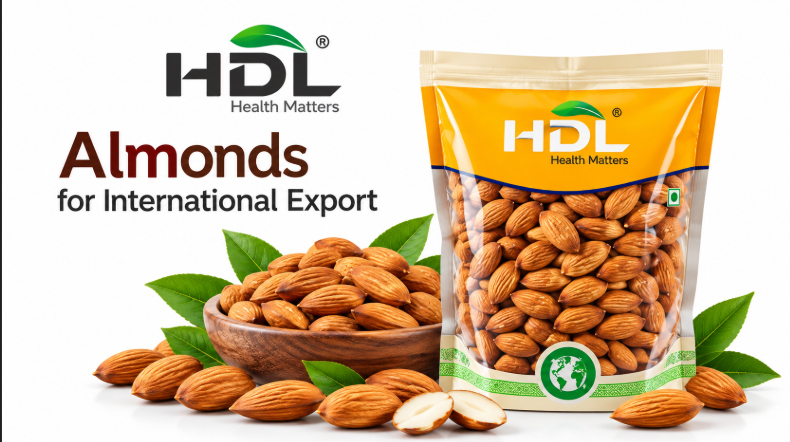
Almonds are widely consumed in snacks, bakery products, confectionery, cereals, health foods, and food manufacturing. With growing demand across international markets, choosing the right quality almonds has become an important part of successful food export operations.
For an Indian Food Exporter, selecting almonds for international export involves more than checking their appearance or buying at the lowest price. Exporters need to evaluate almond variety, size, grade, freshness, moisture, cleanliness, packaging, storage conditions, food safety, documentation, and destination-market requirements.
A well-defined quality-control process helps exporters maintain product consistency, reduce shipment risks, meet buyer specifications, and build long-term relationships with international customers.
This guide explains how to choose quality almonds for international export and the key factors exporters should consider before purchasing, packing, and shipping almonds overseas.
Why Almond Quality Matters in International Export
Almonds may travel long distances before reaching an importer, distributor, retailer, food manufacturer, or final consumer. During transportation and storage, temperature, humidity, oxygen exposure, handling, and packaging can affect product quality.
1. Choose the Right Almond Variety
The first step in selecting quality almonds is choosing a variety that matches the requirements of the target market and end application.
Different buyers may have different preferences based on whether almonds are intended for retail consumption, bakery products, confectionery, snacks, food processing, or other applications.
Before sourcing almonds, determine:
- Target export market
- Intended application
- Almond variety
- Kernel size
- Grade
- Appearance requirements
- Packaging format
- Shelf-life expectations
- Buyer specifications
For premium retail products, buyers may prefer attractive and uniform kernels. Food manufacturers may have different requirements based on their processing needs.
The right almond is therefore not necessarily the largest almond. It is the almond that consistently meets the agreed buyer specification.
2. Check Almond Size and Grade
Size and grade are important quality parameters when buying almonds for export.
International buyers may specify a particular size or grade depending on their application. Exporters should avoid relying only on informal descriptions and should clearly define specifications in the purchase agreement.
Important parameters may include:
- Almond variety
- Kernel size
- Grade
- Whole kernel percentage
- Broken kernel tolerance
- Defect tolerance
- Appearance
- Moisture specification
- Packaging requirements
Clear specifications help exporters and buyers avoid misunderstandings during commercial transactions.
3. Inspect Almond Appearance and Kernel Quality
Visual inspection is an important first step in almond quality control.
Good-quality almonds should have a clean and natural appearance and should be free from obvious signs of deterioration.
During inspection, check for:
- Discoloration
- Mold
- Insect damage
- Insect holes
- Excessive shriveling
- Broken kernels
- Foreign materials
- Excessive skin damage
- Unusual surface marks
However, appearance alone cannot confirm every aspect of almond quality. Some problems require laboratory testing or additional quality checks.
For this reason, visual inspection should be combined with appropriate testing and supplier documentation.
4. Check Almond Freshness, Taste and Aroma
Freshness is particularly important because almonds naturally contain oils. Unsuitable storage conditions can cause oxidation and negatively affect taste and aroma.
Fresh almonds should generally have a pleasant, natural nutty aroma and an acceptable taste.
Quality inspection should look for:
- Fresh nutty flavor
- Pleasant aroma
- Appropriate texture
- No rancid taste
- No unusual bitterness
- No stale flavor
- No unusual odor
If almonds have been stored for an extended period, exporters should understand their storage history before purchasing.
A product that looks acceptable externally may still have sensory quality issues.
5. Check Moisture and Other Quality Parameters
Moisture is an important consideration when evaluating almonds for international export because unsuitable moisture conditions can contribute to quality deterioration during storage.
Exporters should define acceptable quality parameters according to the product specification, buyer requirements, applicable standards, and destination-market requirements.
Depending on the shipment, appropriate testing may include:
- Moisture
- Microbiological parameters
- Contaminants
- Foreign matter
- Physical defects
- Other buyer-specified quality parameters
Laboratory testing should be performed where required, particularly when destination-market regulations or buyer specifications require documented test results.
6. Check Almonds for Insects, Mold and Foreign Matter
Food safety is a critical part of international almond exports.
Before approving a shipment, exporters should inspect almonds for visible contamination and potential quality problems.
Check for:
- Live insects
- Dead insects
- Insect damage
- Mold
- Foreign particles
- Stones or hard materials
- Unusual odors
- Poor sanitation
- Other visible contamination
Suppliers should maintain suitable hygiene, processing, and storage practices.
Exporters should also verify the food-safety requirements applicable to the destination country before shipment.
7. Verify the Almond Supplier Before Purchasing
Choosing the right supplier is as important as choosing the right almond.
A supplier offering a low price may not necessarily provide consistent quality. Exporters should evaluate suppliers based on their sourcing, processing, storage, quality-control, traceability, and food-safety practices.
Before working with a new supplier, consider checking:
- Business experience
- Processing facilities
- Quality-control procedures
- Food-safety certifications
- Laboratory testing capabilities
- Traceability systems
- Storage facilities
- Export experience
- Available product specifications
- Customer references, where available
For a new supplier, starting with a sample or smaller shipment can help evaluate product consistency before placing a larger order.
8. Select Suitable Almond Packaging for Export
Even high-quality almonds can lose their value if they are packed incorrectly.
Export packaging should protect the product during transportation and storage while helping reduce exposure to moisture, oxygen, contamination, and physical damage.
Depending on the market and product specification, exporters may use:
- Food-grade bags
- Vacuum packaging
- Bulk packaging
- Cartons
- Other suitable food-contact packaging
Good export packaging should:
- Protect almonds during transportation
- Reduce moisture exposure
- Help maintain product quality
- Prevent contamination
- Support the expected shelf life
- Be suitable for food contact
- Include accurate labeling
- Remain intact during handling
Packaging should be selected according to the destination market, transportation method, shipment duration, and buyer requirements.
9. Store Almonds Under Proper Conditions
Proper storage is essential for maintaining almond quality before shipment.
Almonds should be stored in a clean, dry, and suitable environment. Excessive heat, humidity, oxygen, light, pests, and strong odors can negatively affect product quality.
Exporters should maintain:
- Clean storage areas
- Suitable temperature
- Controlled humidity
- Pest protection
- Proper ventilation
- Stock rotation
- Separation from strong-smelling products
A first-in, first-out inventory approach can also help reduce unnecessary storage periods.
Proper storage from the time of purchase until shipment can help maintain consistent product quality.
10. Understand Destination-Country Requirements
One of the most important steps when exporting almonds is understanding the requirements of the destination country.
Requirements can vary between markets and may include different rules for:
- Food safety
- Import procedures
- Product labeling
- Packaging
- Testing
- Certificates
- Documentation
- Maximum permitted contaminant levels
- Buyer-specific specifications
Before shipping, exporters should confirm the applicable requirements with the relevant authorities, importer, customs professionals, and buyer.
Understanding destination-market requirements before shipment can help reduce the risk of documentation problems, customs delays, or rejected consignments.
Almond Quality Checklist for International Export
Before approving an almond shipment, exporters can use the following checklist:
| Quality Factor | What to Check |
| Variety | Matches buyer specification |
| Size | Consistent with agreed range |
| Grade | Meets agreed grade |
| Appearance | Clean and uniform |
| Taste | Fresh and acceptable |
| Aroma | Pleasant and free from unusual odors |
| Moisture | Meets agreed specification |
| Defects | Within acceptable tolerance |
| Insects | No unacceptable infestation |
| Mold | No visible mold |
| Foreign Matter | Meets required limits |
| Packaging | Food-grade and export suitable |
| Testing | Required tests completed |
| Documentation | Complete and accurate |
| Traceability | Batch information available |
Common Almond Quality Problems Exporters Should Avoid
Exporters should pay particular attention to common quality issues that can affect international shipments.
1. Buying Only on Price
The lowest price does not always provide the best commercial value. Product quality, consistency, testing, packaging, and supplier reliability should also be considered.
2. Relying Only on Visual Inspection
Some quality issues cannot be identified simply by looking at almonds. Appropriate testing may be required.
3. Unclear Product Specifications
Vague descriptions can lead to disputes between buyers and suppliers. Specifications should be documented before purchase.
4. Poor Storage
Heat, humidity, pests, oxygen exposure, and unsuitable storage conditions can negatively affect almond quality.
5. Incorrect Packaging
Packaging that does not match the transportation method or destination requirements can increase quality risks.
6. Ignoring Destination-Market Requirements
Exporters should verify import, labeling, testing, documentation, and food-safety requirements before shipment.
Almonds and the Indian Food Export Industry
India has a broad food-processing and export ecosystem. Businesses involved in international food trade work across multiple product categories, including nuts, dry fruits, grains, pulses, spices, snacks, and packaged foods.
The same fundamental export principles apply across these categories: consistent quality, reliable sourcing, appropriate packaging, traceability, accurate documentation, and compliance with destination-market requirements.
For businesses involved in Indian grocery exports, these quality-management practices can help maintain consistency across international shipments.
Similarly, companies involved in Indian Spices exports and Indian Pulses exports need to pay attention to product specifications, contamination control, packaging, documentation, and destination-market regulations.
These principles are also relevant to businesses operating in the wider international food exports market.
FAQ’s :
Choose almonds based on variety, size, appearance, freshness, taste, moisture, cleanliness, packaging, and food-safety requirements. It is also important to check samples and supplier documentation before placing a large export order.
Check the almonds for consistent size, natural appearance, fresh aroma, good taste, mold, insect damage, foreign materials, discoloration, and broken kernels. Visual inspection should be supported by appropriate quality testing when required.
Freshness affects the taste, aroma, texture, and shelf life of almonds. Since almonds contain natural oils, unsuitable storage conditions can cause oxidation and rancidity. Proper storage and quality checks help maintain freshness during international transportation.
Almonds should be packed in suitable food-grade packaging that protects them from moisture, oxygen, contamination, and physical damage. Packaging should also match the shipping method, transportation period, labeling requirements, and buyer specifications.
Proper storage helps protect almond quality during the period between processing, packing, and shipment. Almonds should be kept in a clean, dry, controlled environment and protected from excessive heat, humidity, pests, light, and strong odors.
Final Thoughts
Choosing quality almonds for international export requires more than checking appearance and price. Exporters need a systematic approach that covers sourcing, grading, freshness, moisture, food safety, packaging, storage, testing, documentation, and destination-market requirements.
Most importantly, quality should be controlled at every stage of the supply chain.
For an Indian Food Exporter, consistent product quality can help create stronger relationships with overseas buyers and support long-term business growth. The same principle applies across Indian grocery exports, Indian Spices exports, and Indian Pulses exports.
By selecting reliable suppliers, defining clear product specifications, testing where required, and using appropriate packaging and storage practices, exporters can reduce quality risks and deliver almonds that meet international buyer expectations.
In a competitive international food exports market, consistency is one of the most valuable advantages an exporter can build. A well-managed quality process not only protects each shipment but also helps create trust, repeat orders, and sustainable international business relationships.